


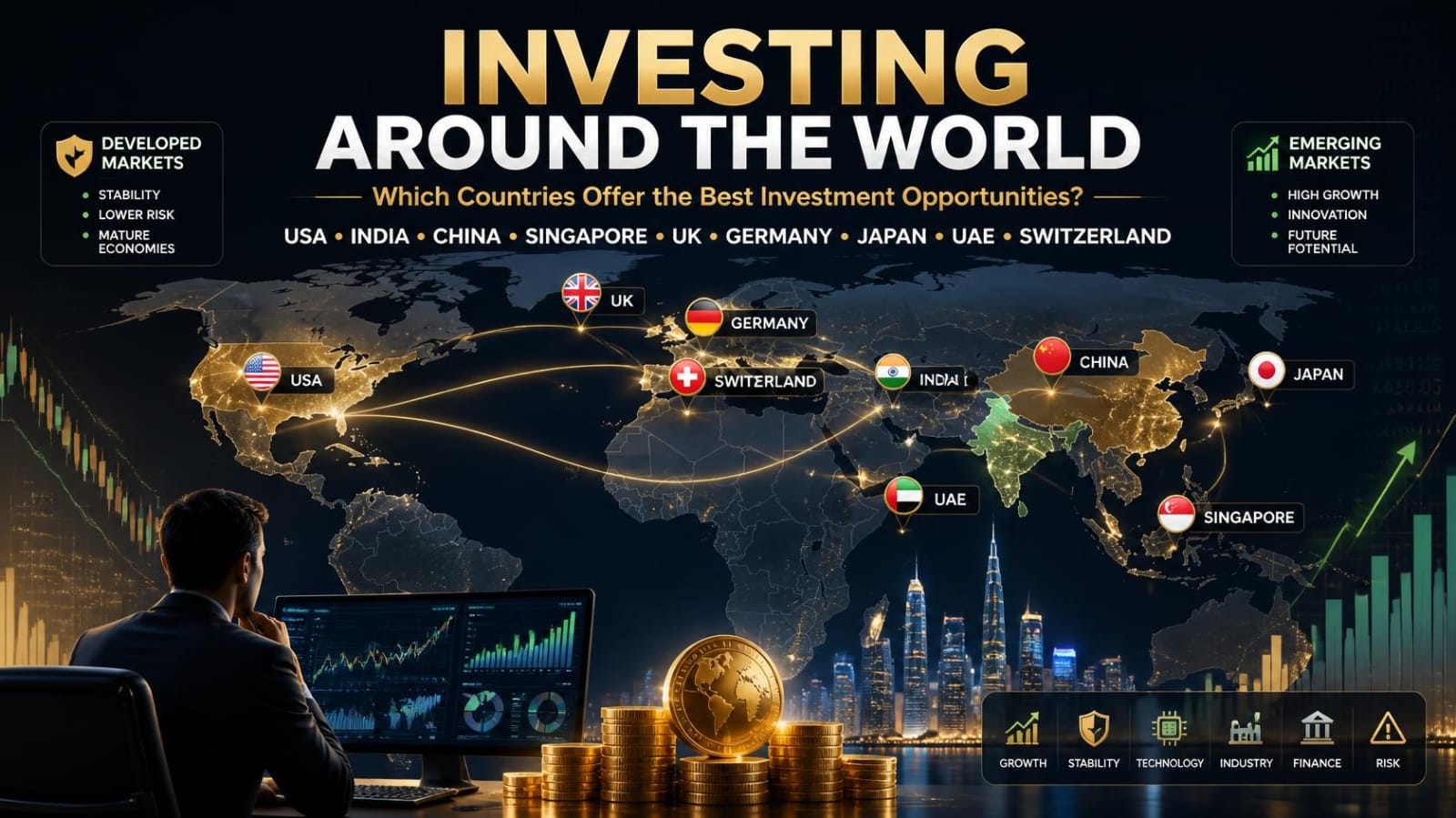
Investing is no longer limited to buying stocks or property in your own country. Today, investors can look across the world for opportunities in growing economies, established financial markets, emerging industries, and attractive business environments. However, every country comes with different levels of risk, taxation, economic growth, market stability, and investment opportunities.
So, which countries are the most attractive for investors? The answer depends on whether you prioritize growth, stability, income, or long-term wealth creation.
United States: The Global Investment Giant
The United States remains one of the world’s most important investment destinations. Its economy is highly diversified, with major companies in technology, finance, healthcare, manufacturing, energy, and consumer goods.
The U.S. stock market offers access to some of the world’s largest companies, while sectors such as artificial intelligence, semiconductors, cloud computing, and biotechnology continue to attract investors.
The major advantage is market depth and diversification. The disadvantage is that many leading companies can already have high valuations, making some investments expensive.
India: High Growth with Higher Risk
India has become increasingly attractive to investors because of its large population, expanding middle class, digital economy, infrastructure development, and growing domestic consumption.
Industries such as technology, banking, manufacturing, renewable energy, pharmaceuticals, and telecommunications provide numerous opportunities.
India can offer higher growth potential than many developed economies, but investors should also consider risks such as market volatility, inflation, regulatory changes, and currency movements.
For long-term investors willing to accept volatility, India can be an important growth market.
China: A Powerful but Complex Market
China has one of the world’s largest economies and is a major player in manufacturing, technology, electric vehicles, renewable energy, and consumer markets.
Its enormous domestic market creates significant business opportunities. However, foreign investors also face greater regulatory uncertainty and geopolitical risks compared with some other major markets.
China can therefore offer substantial opportunities, but investors need to understand the country’s unique political, regulatory, and economic environment.
Singapore: Stability and Business-Friendly Policies
Singapore is a small country with a major role in global finance and trade. Its strong institutions, developed financial system, political stability, and business-friendly environment make it attractive to international investors.
Singapore may not offer the explosive growth potential of some emerging economies, but it is often considered attractive for investors who value stability, strong infrastructure, and access to Asian markets.
United Kingdom: A Mature Financial Centre
The United Kingdom, particularly London, remains one of the world’s major financial centres. Investors can access established companies across banking, healthcare, consumer goods, energy, and other industries.
The country’s mature market can provide stability and diversification. However, economic growth may be slower than in some emerging markets, and investors must consider currency and economic risks.
Germany: Industrial Strength
Germany is Europe’s largest economy and is famous for engineering, automobiles, manufacturing, chemicals, and industrial technology.
Investors interested in established industrial companies may find Germany attractive. At the same time, Europe’s energy costs, demographic challenges, and slower economic growth can create pressures for businesses.
Japan: Stability, Technology and Innovation
Japan offers investors exposure to a highly developed economy with globally recognized companies in automobiles, electronics, robotics, machinery, and technology.
Japan’s mature financial market and strong corporate sector are advantages. However, its aging population and historically slow economic growth are important factors investors should consider.
United Arab Emirates: A Growing Investment Hub
The UAE, particularly Dubai and Abu Dhabi, has developed into an important international business and investment centre.
Real estate, tourism, financial services, logistics, energy, and technology are key areas of interest. Its strategic location between Europe, Asia, and Africa also provides an advantage.
However, investors should carefully evaluate property valuations, market cycles, and the specific regulations applying to their investment.
Switzerland: Wealth Preservation and Stability
Switzerland is widely associated with financial services, strong institutions, and economic stability. It can be attractive to investors who prioritize wealth preservation and diversification.
Its economy is smaller than that of the United States or China, so opportunities may be more limited in certain high-growth sectors.
Which Country Is Best for Investment?
There is no single “best” country for every investor.
The United States may be attractive for global diversification and access to large technology and multinational companies. India may appeal to investors seeking long-term emerging-market growth. Singapore and Switzerland may be more suitable for those prioritizing stability, while countries such as Japan, Germany, and the UK provide access to mature developed markets.
The UAE can provide exposure to a rapidly developing international business hub, while China offers access to one of the world’s largest economies but with additional regulatory and geopolitical considerations.
The smartest approach is not necessarily choosing one country. Instead, investors can consider diversification across different countries, industries, currencies, and asset classes.
Final Thoughts
Global investing can create opportunities that are unavailable in a single domestic market. But higher potential returns often come with higher risks.
Before investing internationally, investors should consider economic growth, political stability, taxation, currency movements, regulations, market valuations, and their own risk tolerance.
Ultimately, successful investing is not about finding the country that will perform best next year. It is about building a diversified portfolio that can survive different economic conditions and compound wealth over the long term.
Disclaimer: This article is for educational purposes only and should not be considered financial advice. Investors should conduct their own research or consult a qualified financial professional before making investment decisions.